Rubber Tree
Many plant species produce natural rubber. Considerations of quality and economics, however, limit the source of natural rubber to one species, namely Hevea brasiliensis.
It is a native of the Amazon basin and introduced from there to countries in the tropical belts of Asia and
Africa during late 19th century. It can be termed as the most far reaching and successful of introductions in
plant history resulting in plantations over 9.3 million hectares, 95 per cent of it across the globe in Asia.
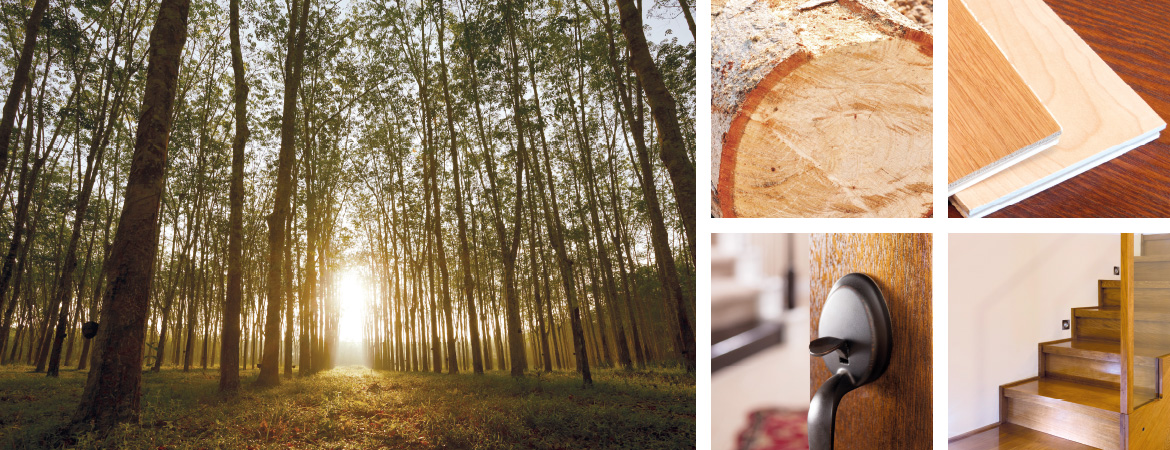
Hevea brasiliensis, also known as the Para rubber tree after the Brazilian port of Para, is a quick growing, fairly sturdy, perennial tree of a height of 25 to 30 meters. It has a straight trunk and thick, somewhat soft, light brownish gray bark. The young plant shows characteristic growth pattern of alternating period of rapid elongation and consolidated development. The leaves are trifoliate with long stalks. The tree is deciduous in habit and winters from December to February in India. Refoliation is quick and copious flowering follows. Flowers are small but appearing in large clusters. Fruits are three lobed, each holding three seeds, quite like castor seeds in appearance but much larger in size. The seeds are oil bearing.
Hevea brasiliensis is a tropical tree. It grows best at temperatures of 20-28°C with a well-distributed annual rainfall of 1,800-2,000 mm. It grows satisfactorily up to 600 metes above sea level (but is capable of growing much higher - to at least 1000 metes near the Equator), and will perform on most soils provided drainage is adequate. Hevea tends to be damaged by high winds. Its required temperature and rainfall define its prime growing area as between the 10° latitudes on either side of the equator, but is cultivated much further north (Guatemala, Mexico and China) and south (Sao Paulo region of Brazil). Further discussion on environmental factors is available.
The rubber tree may live for a hundred years or even more. But its economic life period in plantations, on general considerations is, only around 32 years – 7 years of immature phase and 25 years of productive phase. Commercial cultivation of rubber in India was started in 1902.
Hevea trees convert inorganic nutrients from the soil, and carbon dioxide from the atmosphere, into organic carbohydrates which are then turned into rubber latex. The latter passes up the tree through millions of capillary vessels or tubes located in the soft outer bark.
At least once a year the leaves of the tree, which are the sites of carbohydrate formation, die and fall off in wintering, and new leaves are formed. During wintering, which lasts for sixteen weeks, the metabolism of the tree and the constitution of its latex are substantially affected. The yield is also reduced, and this, together with other climatic factors, accounts for marked seasonal variations in NR production in producing countries.